Introduction
Welcome to the Paranet!
What Is the Paranet?
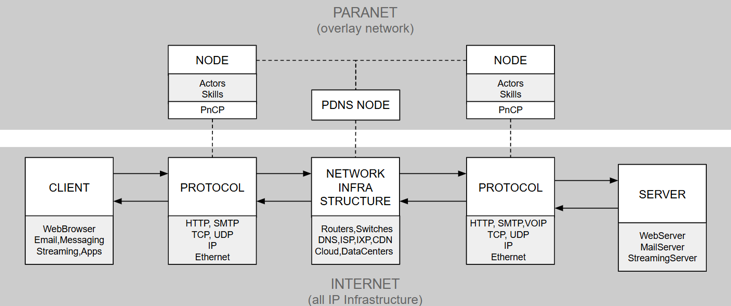
The Paranet is a secure skills network for intelligent machine and human collaboration. It utilizes existing IP infrastructure and, for all intents and purposes, it's another internet. There are many "internets" such as the Web, the Onion Router (Tor), and the Internet of Things (IoT). The Web supports social networking, e-commerce, entertainment, and so on. IoT is a network of connected devices, and Tor is for secure, anonymous communication. The Paranet is fundamentally designed for work productivity, and we consider it to be the Internet of Work (IoW).
Key Terms
Before diving into the documentation or writing code, it's important to understand key terms, features, and concepts. In technology, most words have been used before. We want to ensure we are all starting on the same page.
| Term | What it means on the Paranet | What it doesn't mean |
|---|---|---|
| Actor | An autonomous entity on the Paranet that can perform skills and make requests for the skills of other actors on the Paranet. An Actor has Skills and is a primary "worker" on the Paranet. | A specific type of AI or machine learning model. In many languages and platforms this is similar to an Agent. |
| Skill | A specific capability or function that an Actor can perform. Skills are the building blocks of Actors and can be combined to create complex workflows. Skills are matched at runtime i.e. they are late-bound. | A general term for any ability or talent, not necessarily related to AI or distributed systems. |
| Skill matching | The process of finding Actors with the right Skills to perform a specific task or workflow. This is a key feature of the Paranet. Skills can be matched within a given node or when federated to other nodes, across nodes. | A simple search or filtering mechanism that does not consider the distributed nature of the network or the specific capabilities of Actors. |
| Paraflow | The workflow language used to define and execute workflows on the Paranet. It allows for the creation of complex workflows that can be executed by Actors. | Paraflow does not replace existing languages e.g. we often use Python or TypeScript called from Paraflow. |
"As machines become increasingly advanced, the most important question isn't how humans can maintain control but rather how the two can collaborate, with people defining the goals while machines help strategize efficient, creative ways those goals might be reached."
— Garry Kasparov (world chess champion)
The Paranet is as much an "operating system" as it is a network. Effectively, it is the first general-purpose distributed intelligence operating system. The processes are called actors, the skills broker is the kernel. Actors originated from early AI research at MIT, and several technologies have been based on them for distributed concurrent processes. Our actors are next-generation types that have their own AI planner language to run on the operating system. They are heterogeneous, decoupled processes that run over the network with no process dependencies. Their language, Paraflow, is the first of its kind to emulate how humans plan, complete goals, manage workflows, and collaborate to perform work collectively.
How to Use These Docs
On the left side of the screen, you'll find the documentation navigation bar. The pages are categorized by different areas of the technology that make up or support the use of the Paranet.
We have the classic Getting Started section, Paraflow—our general-purpose workflow language—and various Developer Tools we're consistently building upon and maintaining to support your Paranet journey.
However, you can read them in any order or skip to the pages that apply to your use case.
On the right side of the screen, you'll see a table of contents that makes it easier to navigate between sections of a page.
Prerequisite Knowledge
To get the most out of our docs, it's recommended that you have a technical background. You'll find workflow and state machine principles in Paraflow, as well as React and JSON-based knowledge requirements within features we offer in our client Paracord.
Also, having a basic understanding of the Actor Model, popularized by Carl Hewitt, will help you grasp the philosophy behind the technology.