Learning Requirements
A Paraflow developer should have proficiency in asynchronous languages like JavaScript and Python and asynchronous programming using REST APIs and HTTP requests. Understanding pub-sub as a messaging pattern for decoupled communication and gRPC as a framework using the HTTP/2 protocol are essential for using Paraflow and PnCP skills-based interactions in a semantic protocol.
Just like the Web introduced the concept of information sharing language (HTML) and an information transfer protocol (HTTP), the Paranet introduces an intelligence sharing language (Paraflow with skills) and a skill matching protocol (PnCP). Instead of creating Internet domains and building web servers with web content, Paranet developers create paranets and build nodes with actors with skills.
With the Web came new technology roles such as webdevs, categorized as front end, backend, and full stack. Also new were SEO specialists, Web designers, and all the new languages—PHP, JavaScript, and HTML/CSS.
For the Paranet, there will be new kinds of programming and technology roles too. The networks are semantically based so new kinds of network designers will be required. It has a new security model which will produce paranet security engineers. In addition to object-oriented or functional programming, programmers will be doing autonomous programming where they build Paraflow code that is based on AI planners. There will be roles for cataloging all the skills needed by an organization and roles for building algorithms to optimize how skills are utilized. The paranet is an intelligent network sharing intelligence requiring a new technology mindset on how to organize this intelligence.
Paraflow uses hierarchical goal trees (HGTs) as a fundamental construct for its planning capability, with the language’s runtime and actor execution model serving as an implicit HGT Planner. This integrated approach enables actors to reason, adapt, and execute plans deterministically (e.g., AMS) by evaluating HGTs locally, coordinating via PnCP, and leveraging ledger data, without a separate planner component. This design aligns with the Paranet’s distributed, autonomous ethos, ensuring precision and scalability where bespoke code in common languages with workflow extensions to incorporate planning and workflow applications fall short.
Network Design
The primary objective of developing on the Paranet is building paranets by creating nodes, writing actors, and publishing their skills. Paranets networks are created by adding nodes to a paranet and affiliating nodes and paranets. Affiliation is the means of networking on the Paranet such that paranets and nodes can match skills, notify, and observe each other. Each node runs on an OS and uses PnCP to discover and collaborate with other nodes. Specifically, the actors of each node are using skills of actors on their nodes and other nodes across their affiliated paranets.
Each node at affiliation time determines the skills that it will share and the rules for sharing. Within an organization, skills may generally be shared with reciprocity. However, department paranets and nodes may restrict access to certain actors and skills. For example, an AMR (Autonomous Mobile Robots) may not receive skill requests from any other nodes than the WMS application and floor supervisors (human) actors across two nodes.
The Paranet is federated such that nodes can run anywhere—cloud, IT servers, laptops, phones, IoT devices, and so on. As long as the protocol is implemented (implicit to a node), then the paranet can affiliate with other paranets regardless of location.
Programming
The 3 generations of programming demonstrate the progression away from human-centered interaction with machines to machine-centered interaction where the machines of the Paranet are actors that have the intelligence to collaborate on their own without managing them. With humans out of the requirements, actors need to be orchestrated. Since everything is an actor with skills on the Paranet, one or more orchestration actors are used to manage the operations of a given paranet.
Continuing with the factory analogy, let’s say you have a factory with hundreds of AMRs. The common way to manage robots today is to give them physical AI autonomy where they can recognize objects in the path and avoid hitting them for safety reasons. Then recognize where they are to perform their tasks such as lifting a palette. These robots are being controlled by a client-server-based fleet management system (FMS). Each robot sends back its location and status. The FMS tracks each location and status of each of the robots. When the wireless signal of a robot is unable to connect to the FMS, the robot can no longer function. The plan for each robot is exclusively managed by the server. Compounding this problem is that factory’s other robots with their FMSs. Further compounding are the human workers, applications, devices and so on that each of the FMSs must interoperate with or have some level of awareness.
Autonomous programming on the Paranet allows decisions to be made by the most appropriate actor in the moment. While there will be factory orchestrators such as dock receiving, dock loading, material handling and so on, these are not centralized. They are decoupled on the network running their own plans but subscribing the events and responding to requests from other actors on the network.
Each robot from each vendor can have its own plan based on the needs of the factory and its operational paranet. For a forklift that loses connectivity it can complete its plan, say moving palettes from location X to location Y and repeat its task goals if its plan is coherent. The activity is recorded to its local ledger and joined with the network when connectivity is re-established.
In situations where robots are in collaboration, they can have the intelligence to optimize tasks (who is closer now) and to delegate work. While doing so, other actors on the network can observe their plan directly or observe their work and decisions history. Such actors can be intelligent software actors or humans doing operational analysis. Further, an ERP system might have a new, urgent request that is made to the network where a robot can reprioritize and suspend its current workflow from its plan to hand the request. When completed it can determine if it should resume where it left off.
Autonomous programming is a superset or augmentation of asynchronous programming with additional state data and the ability for actors to observe, plan, and delegate. Other languages are working below the autonomous layer where most of the work is done. Autonomous programming is largely about orchestration, collaboration, workflow, planning, and security. The Paranet enable these five characteristics across IT (Information Technology) and OT (Operational Technology) realms.
Autonomous Technology (AT) is the new, conceptual technology realm distinct from IT and OT that requires no new hardware to deploy. It’s a conceptual computation space.
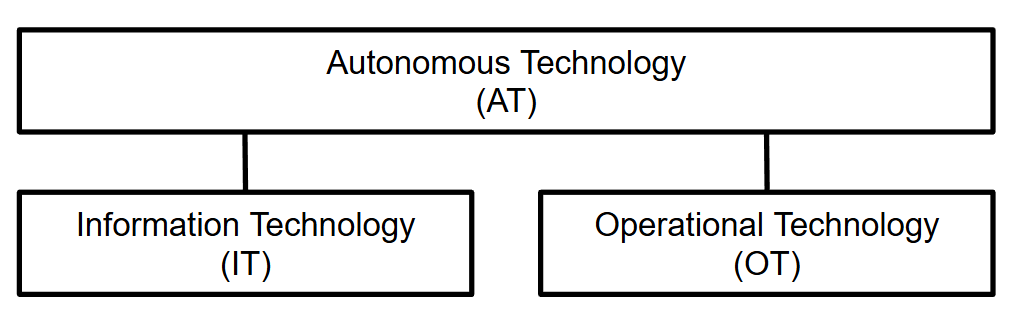
The Paranet allows enterprise software and devices to co-exist as collaborative actors secured by Negative Trust Security in the overlay (See NTS below). In the example of robots, they are OT devices but are collaborating with IT-based applications such as ERP that become actors on the network.