Skills and Skill Matching
Skills on the Paranet are semantic capabilities that actors publish, defining specific actions or functions they can perform using a hierarchical namespace for clarity and intent. Skill matching, facilitated by PnCP, dynamically pairs actors’ requests with available skills across the network, ensuring deterministic collaboration without predefined dependencies. This process enables real-time, brokered task execution, distinguishing it from static service discovery by aligning actions with operational goals in a distributed, autonomous environment.
Diagram D2 shows a color coded mapping of paranets, nodes, actors and skills.
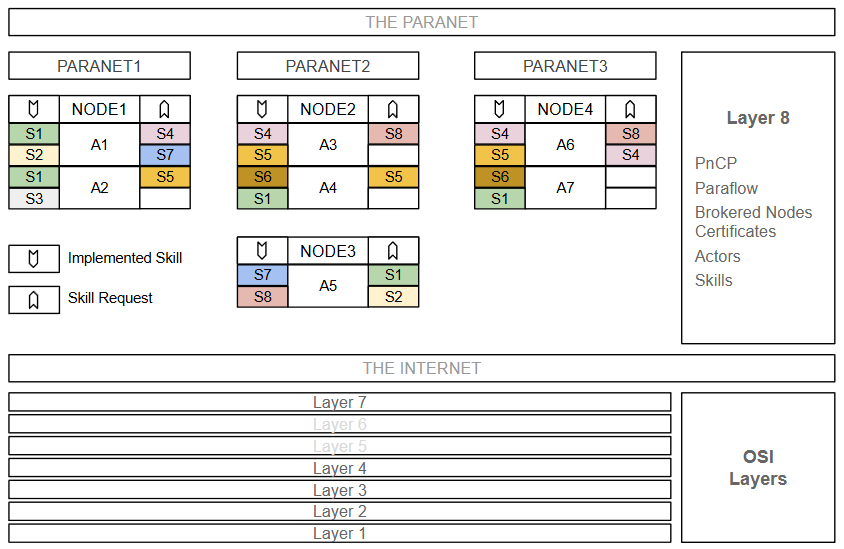 Diagram D2
Skill S1 is implemented by:
-
PARANET1 > NODE1 > A1
-
PARANET1 > NODE1 > A1
-
PARANET2 > NODE2 > A4
-
PARANET3 > NODE4 > A7
Skill S1 is requested by:
- PARANET2 > NODE3 > A5
Skills are functions of an actor that are provided to a network as a dynamic RPC. Actors of the same node can have the same skills. Actors can request skills directly or let the nodes determine the best actor skill based on cost criteria (not in current devkit release). The more autonomous a network, the more skills that are determined from the intelligence of the network via the nodes. As skills scale, and ledger data is analyzed, the network will optimize skill matching.
Actors present their skills to their nodes. Since skills are the basis of the intelligence of the Paranet, nodes store the skills each actor publishes and the skills each actor requests. The nodes perform aggressive filtering of requests to ensure that if an actor requests a skill that it has not been authorized to request or if it performs a skill that it has not declared that it has, it is removed from any further activity.